
How to Design a Story Character From Role to Visual Brief
A practical bridge between character writing and visual design, with concrete decisions another artist or image model can review.
Written and reviewed by Comics Maker Editorial
Direct answer
Start with the character's story role, goal and contradiction. Turn those ideas into a readable silhouette, clear face and body features, constructed clothing, one signature prop and a limited color palette. Test the design in a neutral pose, then separate the features that must stay consistent from details an artist may change.
What to get right
- Start with the character's job in the story, not a list of fashionable features.
- Make personality visible through posture, maintenance, clothing choices and carried objects.
- Use a limited hierarchy of recognition anchors instead of describing everything equally.
- Approve one readable concept before action scenes, expressions or consistency work.
Product claims were checked against the current Comics Maker workflow on the date shown above. External references are used for publishing and craft guidance; generated output still requires human review.
Start with role, goal and contradiction
Visual design has to serve a story. Write what the character does, what they want in the current project, what makes the goal difficult and what they refuse to admit. A flood-tunnel surveyor who maps dangerous infrastructure but cannot ask for help suggests a different body language and equipment history than a fearless adventurer with the same coat.
Purdue OWL recommends connecting character goals to conflict and distinguishes character-first from plot-first development. Both routes can work. If the character comes first, build pressure that tests their habits. If the plot comes first, create someone with a personal reason to enter that conflict. The design should carry evidence of that connection rather than adding decoration after the story is written.
Build a silhouette that reads before the details
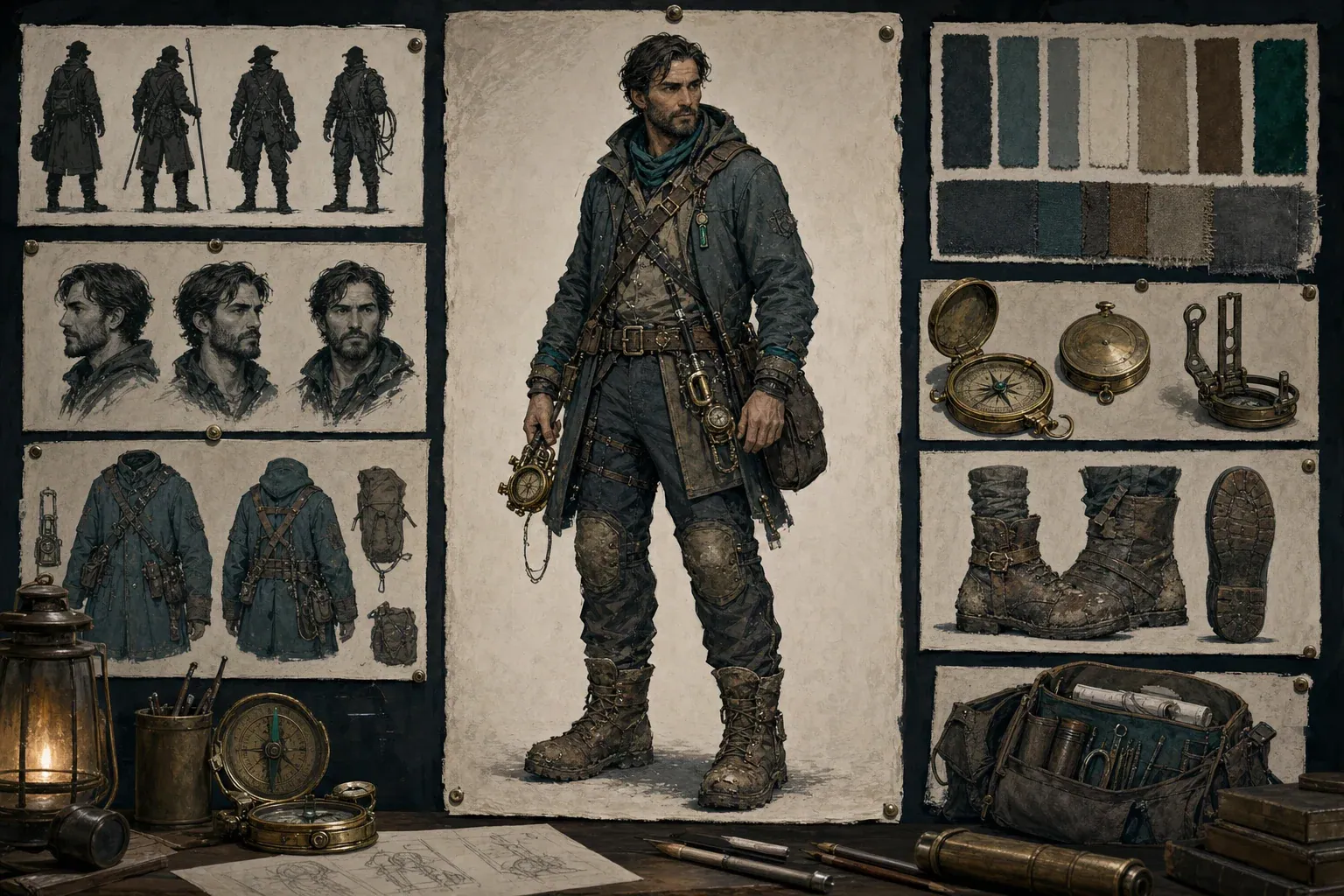
Reduce the character to a dark shape. Can you identify the body proportions, stance, outer garment and signature object? A long survey coat, compact field bag and low-held compass can establish purpose before the viewer sees a face. If the silhouette depends on six tiny accessories, it will disappear in a comic panel, mobile game portrait or animation thumbnail.
Body description should be visual and respectful. State height impression, proportions, stance, shoulder or limb shape and movement quality when they matter. Avoid using identity as shorthand for temperament. Age, disability, culture and occupation require specific research when they affect clothing, equipment or behavior.
Turn face, clothing and history into visible construction
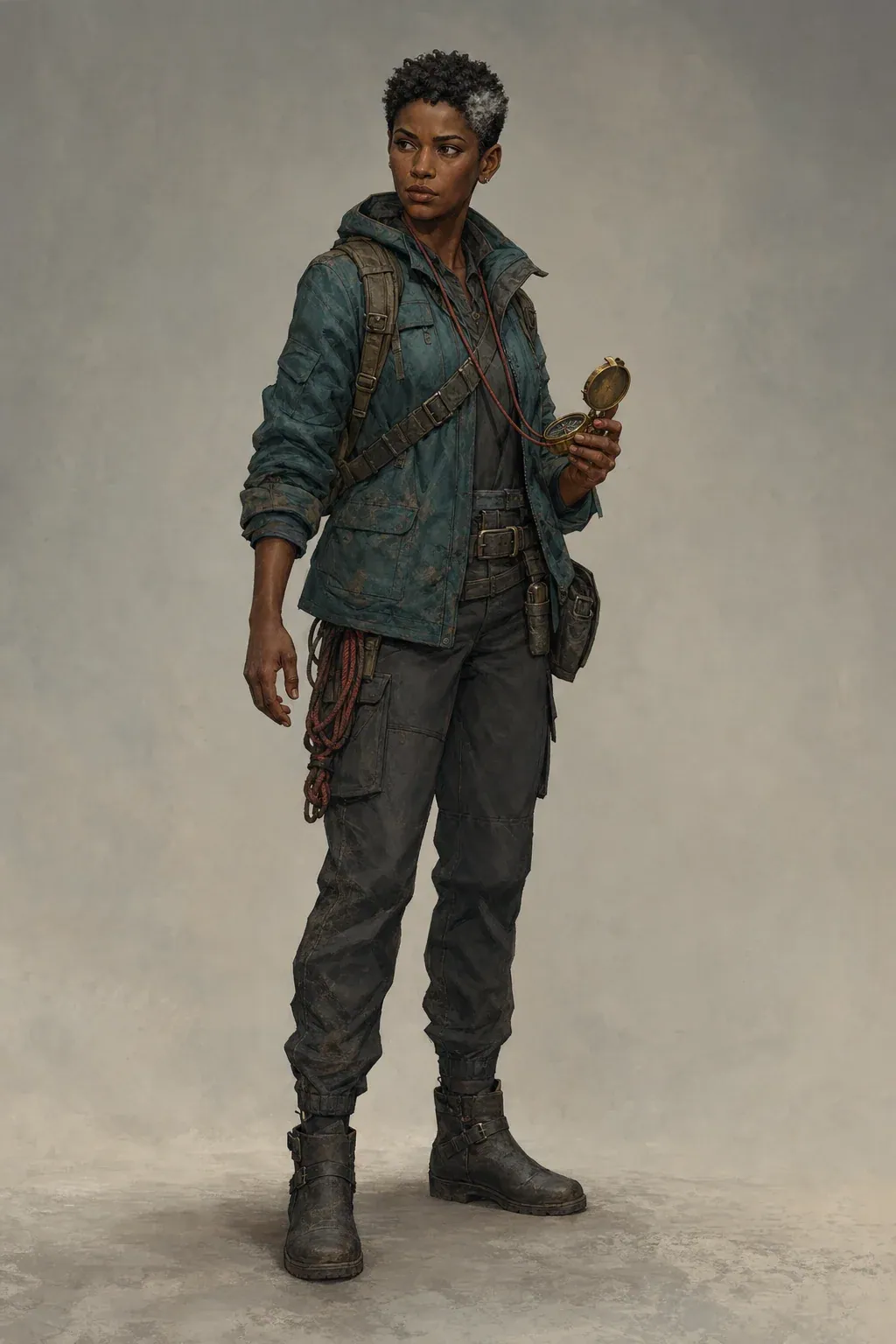
Choose two or three recognition anchors for the head: face shape, hair construction, brows, glasses, a scar, a repeated expression or another stable feature. Do not treat a pile of adjectives as a design. ‘Sharp, beautiful, mysterious eyes’ is hard to reproduce. ‘Deep-set eyes under straight brows, with round repair goggles resting above the forehead’ gives an artist something observable.
Wardrobe needs layers, closures, cuffs, footwear, material and wear. Backstory belongs only when it leaves evidence: patched knees from field work, a removed insignia, adapted fasteners, sun fading or a carefully preserved token. Personality can change posture, how neatly tools are maintained and whether the character chooses a practical or ceremonial object.
- Name the base layer, outer layer and footwear.
- Explain how the garment opens, fastens and carries equipment.
- Use wear where the character's work would actually create it.
- Keep one primary signature object and remove items that compete for attention.
Choose a palette and pose that prove the design
Assign colors by role: dominant outer garment, neutral base, hardware and one small accent. This is more useful than a long row of unrelated hex values. Check contrast in grayscale and at the smallest expected display size. A limited palette also makes later panels easier to control.
Use a neutral three-quarter full-body pose for the first approval. It exposes the face, silhouette, hands, footwear, garment layers and prop. An action pose can sell mood but hide construction. A portrait works when the deliverable is truly face and upper wardrobe; it cannot prove boots, proportions or equipment placement.
The AI character creator turns these decisions into an editable specification before requesting one concept image. Keep the specification as the primary design reference and revise the line that failed instead of adding more style adjectives.
Write a character brief another artist can use
Divide the brief into fixed and flexible details. Fix body and face structure, recognition anchors, key garment layers, palette roles, signature prop and intended medium. Leave background, incidental lighting and decorative texture flexible unless they define identity. Otherwise a collaborator may preserve accidental artifacts while changing the features that matter.
State the output honestly. One concept image is not a turnaround, model sheet, animation rig or trained consistency model. After approving the design, use the comic character maker when a recurring comic cast needs reusable visual traits across panels, or the anime character creator when the required output is specifically anime-styled.
| Fix | Leave flexible |
|---|---|
| Face and body structure | Incidental background |
| Recognition anchors | Temporary lighting |
| Garment hierarchy and palette roles | Minor surface texture |
| Signature prop and medium | Nonessential decorative objects |
Review originality, anatomy and production fit
Check whether the character resembles a protected character, a real person or a living artist's signature style too closely. Research culture, occupation and equipment rather than combining stereotypes. If a photo reference is necessary, obtain permission and use a workflow designed for reference images.
Inspect face, hands, footwear, clothing construction, object count, image framing and background. Image models can change anatomy, small symbols, patterns and text. A promising identity with one bad detail needs a targeted revision. A generic identity needs a stronger role, silhouette and recognition hierarchy before another image is made.
Next steps
Continue with the right production tool
Build the first character concept
Turn role, appearance, wardrobe, palette and pose into an editable specification and one reviewable image.
Open the AI character creatorCreate an anime-specific character
Use anime styles, framing, expression controls or a permitted reference image for that narrower output.
Open the anime character creatorPrepare a recurring comic cast
Carry approved identity traits into a longer panel and comic workflow.
Use the comic character makerSources
References used
External references support specific workflow claims. Product behavior is described from the implemented Comics Maker pages.
- Purdue OWL: Writing Compelling Characters
Reference on goals, conflict, believability and selecting physical details that reveal character.
- Purdue OWL: Characters—A Brief Introduction
Question framework for developing values, wants, relationships and behavior beyond surface appearance.
FAQ
Common questions
What should a character design brief include?
Include story role, goal, body and face structure, recognition anchors, clothing layers, palette roles, signature prop, pose, intended medium and the details that must remain fixed.
Should I write the personality or the appearance first?
Start with role, goal and contradiction, then translate them into visible posture, clothing, maintenance and props. Appearance becomes easier to judge when it has a job.
How many colors should a character use?
There is no universal number, but a dominant color, neutral base, material color and small accent create a clearer hierarchy than many equal colors.
Is one generated image a character sheet?
No. It is one flattened concept. Turnarounds, expression sheets, model sheets, rigs and trained consistency systems are separate deliverables.