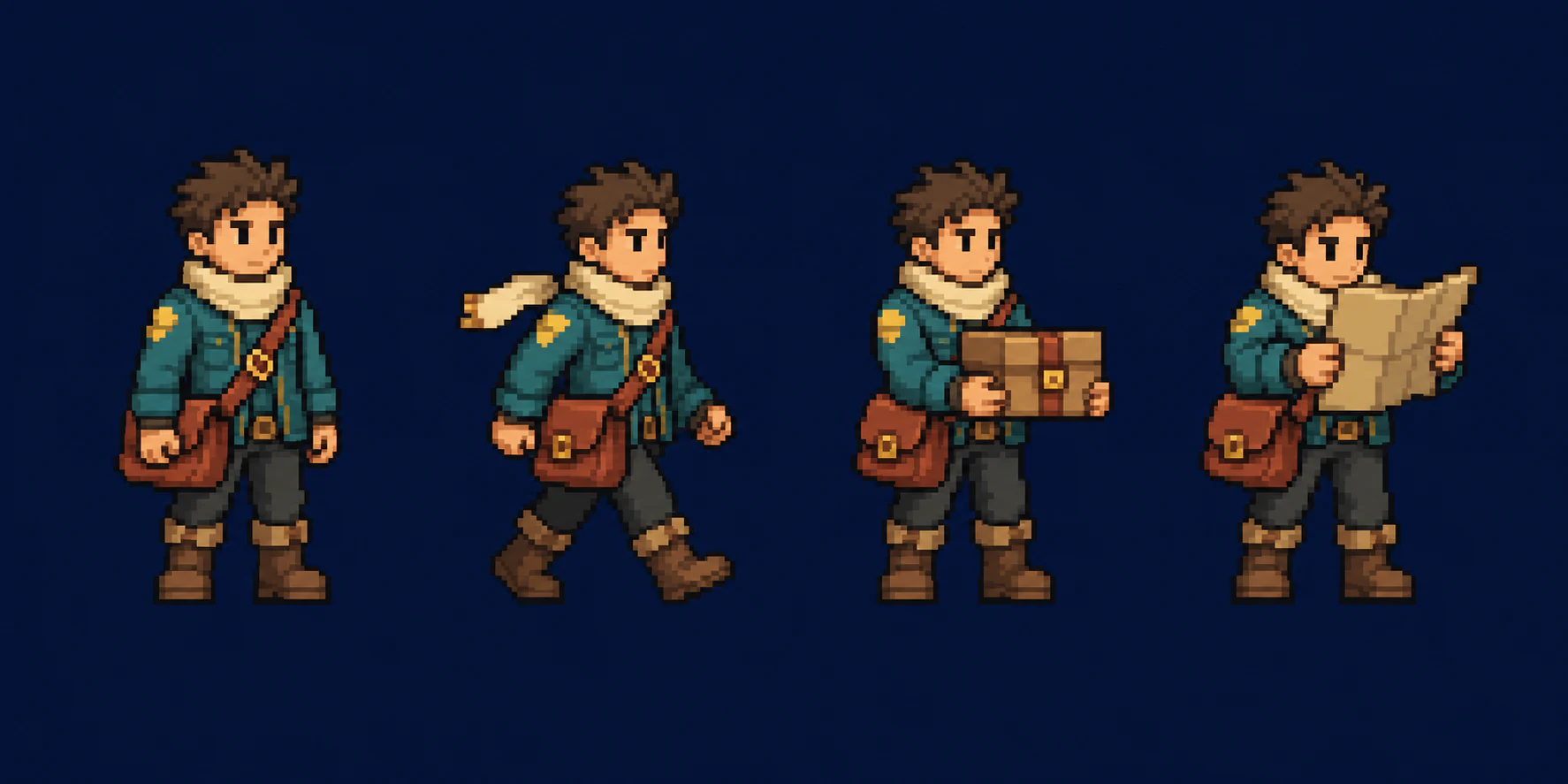
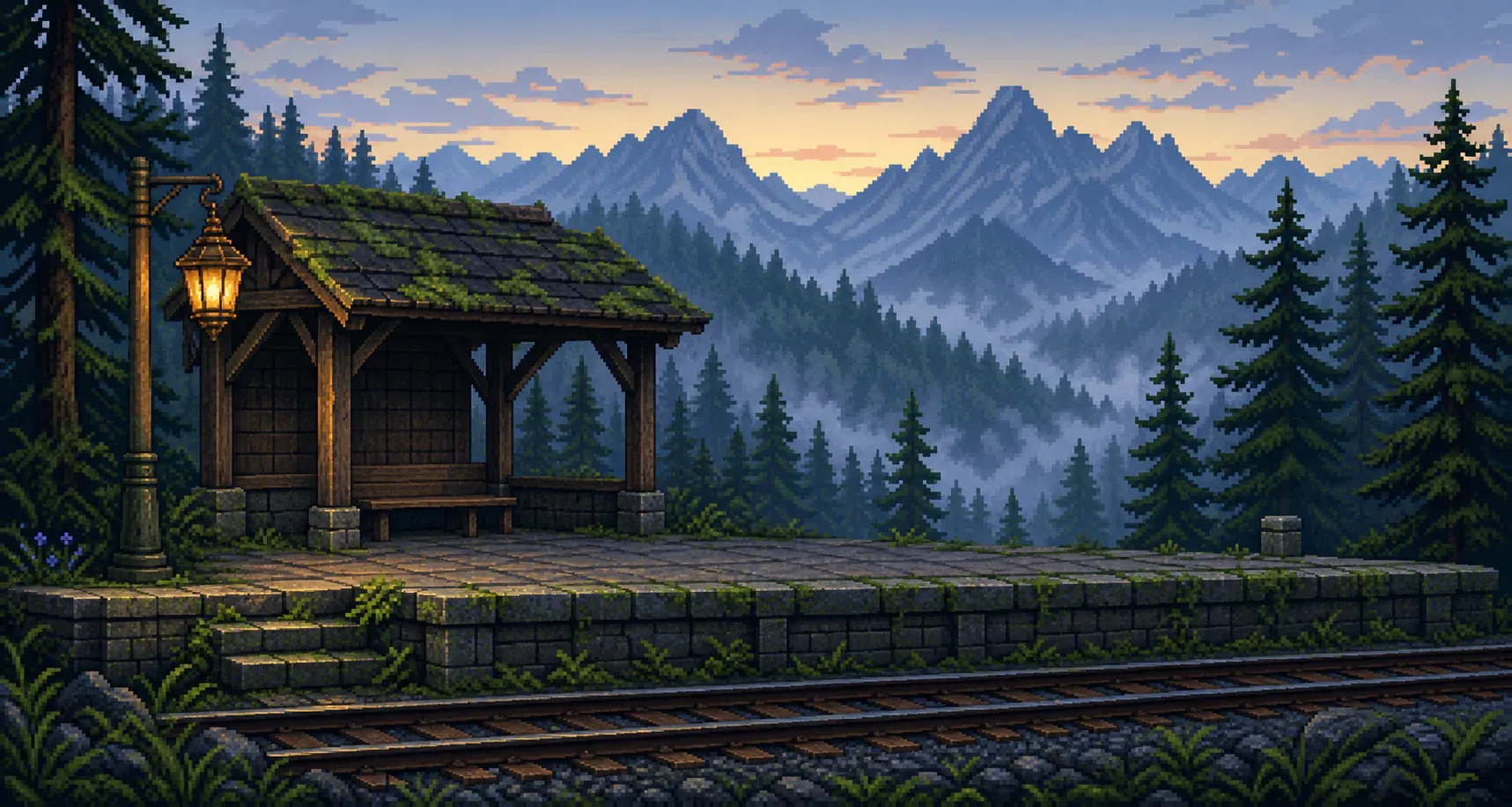
An AI pixel art generator from text is useful when you can describe the asset before you can draw its pixel clusters. The brief should identify one deliverable: a character sprite, a four-pose sheet, a background, or an icon set. Then describe visible facts in production order. For a character, state role, silhouette, pose, clothing, carried object, dominant colors, viewing direction, and any elements that must not appear. For a background, state camera orientation, foreground, middle distance, far distance, landmarks, open areas needed for characters, time of day, and lighting. For icons, list every object and the shared palette, outline weight, lighting direction, and spacing. Concrete nouns and spatial instructions are more useful than broad mood words because you can compare each requested feature with the result.
The logical canvas control is not a promise that the downloaded file will literally measure 16 by 16 or 32 by 32 pixels. The generated image is a larger PNG guided by the selected visual scale. A 16 × 16 request asks for an extremely simple silhouette and very few clusters, while 64 × 64 or 128 × 128 allows more costume, material, facial, and environmental information. A complex brief forced into a tiny logical grid often produces noisy micro-details that only resemble pixel art when viewed at full size. If an exact game-ready canvas is required, reduce or redraw the approved direction in a pixel editor, use nearest-neighbor scaling, and inspect every cluster at 100 percent and at the final display size.
Write one prompt around one reviewable job. “A complete fantasy game” is not an asset brief. “One side-view mountain courier with a square satchel, folded route map, teal jacket, cream scarf, rust boots, readable idle pose, no text, warm sixteen-color palette” is reviewable. The output can be checked for silhouette, palette discipline, object count, pose, unintended symbols, and edge treatment. If the first generation misses an essential feature, change the sentence that controls that feature instead of adding unrelated style adjectives. Keep successful constraints, remove contradictions, and regenerate one variable at a time. This produces a useful visual-development record even when the first draft is not ready for production.