
How to Write a Plot Outline That Connects Every Major Choice
A practical outline method built around cause, choice and consequence—not a list of events that happen to the protagonist.
Written and reviewed by Comics Maker Editorial
Direct answer
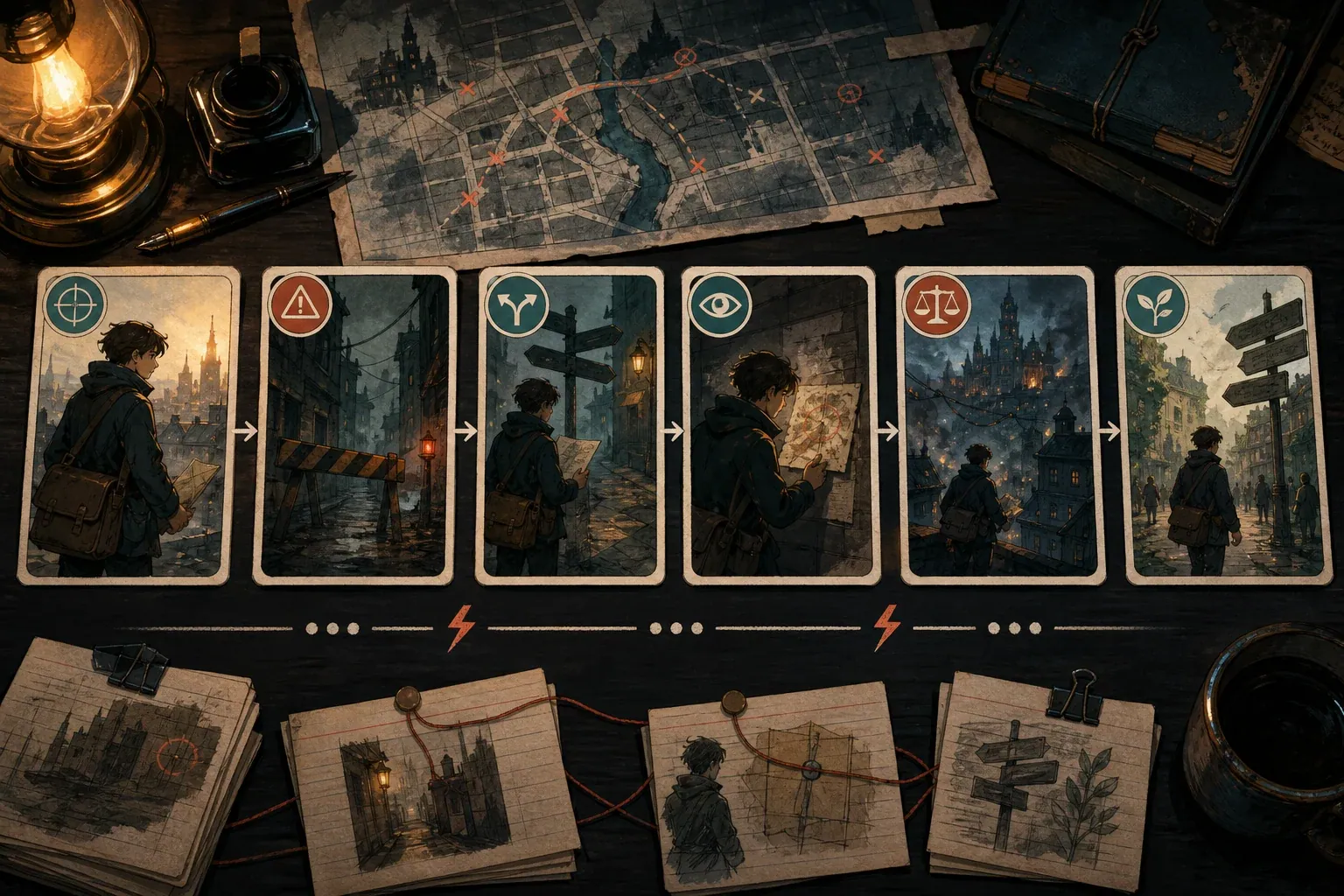
Treat a plot outline as a chain of decisions. The protagonist wants something, pressure blocks the easy path, and every response changes what can happen next. Define the central dramatic question, beginning, midpoint, climax and ending first. Then add only the turning points and scenes needed to connect them.
What to get right
- Write the protagonist as a goal plus a limitation, contradiction and risk.
- Make the midpoint change the plan or the meaning of success.
- Make the climax answer the central question through the protagonist's choice.
- Give every scene a visible action and a distinct narrative purpose.
Product claims were checked against the current Comics Maker workflow on the date shown above. External references are used for publishing and craft guidance; generated output still requires human review.
Build the outline around a dramatic question
A genre and a surprise are not yet a plot. Begin with a protagonist, an immediate goal, an opposing force and a consequence of failure. Then write the question the story will answer. ‘Will a cautious courier expose why an entire district vanished from official maps without endangering the people who live there?’ contains a person, pressure, risk and a conflict that can change shape.
Describe the protagonist with a useful contradiction. ‘Brave courier’ gives the writer little to test. ‘A courier who memorizes every route but refuses to ask for help’ turns competence and weakness into the same trait. Purdue OWL's guidance connects character goals to conflict and notes that physical or environmental details can reveal character without explanation. Carry that principle into the outline: each major choice should test the way this specific person operates.
Write the beginning, midpoint, climax and ending first
The beginning establishes the working world, current desire and disruption. It should end with a response that makes retreat harder. The midpoint is not simply a bigger obstacle; it changes knowledge, strategy, allegiance or the definition of success. The climax answers the transformed conflict through a costly choice. The ending shows what that choice changed.
In the missing-district example, the midpoint discovery might reveal that residents asked to disappear from the map for protection. The courier's goal changes from exposing a crime to deciding how recognition and safety can coexist. The climax cannot be an unrelated rescue. It must force the courier to choose what to reveal, what to protect and what personal certainty to give up.
Use the plot generator to create these fields as an editable planning draft. Do not move into scenes until the four anchors ask and answer the same central question.
| Anchor | Job | Failure test |
|---|---|---|
| Beginning | Disrupt the old routine and provoke action | Could the protagonist ignore this without cost? |
| Midpoint | Change strategy or meaning | Is it only a larger version of the same obstacle? |
| Climax | Force the defining choice | Does coincidence or a new power solve it? |
| Ending | Show the cost and new state | Does it answer a different question from the premise? |
Connect turning points with therefore and but
A turning point closes one route, opens another, changes the cost, reveals information or forces commitment. Read the outline aloud and connect each major beat with ‘therefore’ or ‘but.’ If ‘and then’ is the only honest connection, the story may be episodic rather than causal.
A failed attempt should teach the protagonist something or remove an option. A reveal should change behavior, not simply add lore. A loss should alter a relationship, resource or plan. This does not mean every event must be caused directly by the protagonist; storms and institutions can apply pressure. The next meaningful change should still depend on how the protagonist responds.
- Because the courier hides the damaged map, an inspector follows her.
- But the inspector is protecting residents rather than erasing them for profit.
- Therefore the courier must verify the residents' wishes before publishing evidence.
- But asking for consent reveals her location and removes the safe route home.
Turn the major beats into a scene-by-scene outline
Every scene needs a heading, narrative purpose and visible action or decision. ‘Provide exposition’ is not enough. A stronger purpose is ‘make the courier distrust the only guide who can enter the district,’ paired with an action such as the guide returning a map with one street deliberately inked out.
Combine scenes that repeat the same job. Split a scene only when a real turn creates a new goal, time, place or power balance. Length affects how many attempts, reversals and supporting characters the story can carry, but it does not guarantee a page count. A one-shot comic needs fewer locations and cleaner visual actions than a long prose novel.
When the structure is stable, the comic script maker can translate scenes into pages or scroll beats, panel directions and dialogue. Keep plot and script separate so weak causality is fixed before panel-level writing begins.
Run two plot-outline revision passes
First, test structure. Mark who causes each turning point. Track what the protagonist knows, wants and can still do after every change. Compare premise, midpoint, climax and ending side by side. If several important turns arrive through coincidence, anonymous messages or an authority figure appearing at the right moment, give the protagonist a decision that causes or deliberately uses the event.
Second, make the outline specific. Replace interchangeable locations with spaces that create restrictions and actions. Replace generic clues with evidence that can be planted, misread and reinterpreted. Give supporting characters goals that intersect with the lead's choice. For comics, replace internal explanation with drawable behavior, objects, expressions and spatial changes wherever possible.
- Can the central conflict be stated in one question?
- Does the midpoint change the protagonist's strategy?
- Does every turning point change a later choice?
- Does the climax depend on information already introduced?
- Does the ending demonstrate the cost of the climax?
Common plot-outline problems
An active-sounding protagonist can still be passive if other people cause every decisive change. The story's consequences can sound more serious without actually removing any option. An antagonist can become irrational only because the writer needs an ending. A twist can surprise while making earlier scenes meaningless. These are structural issues, not prose issues.
Do not polish dialogue while the midpoint and climax remain unrelated. Do not add a second villain to make a quiet middle feel busy. Remove or combine repeated scenes, clarify the opposing force's incentives and make the protagonist pay for the solution. The goal is not a rigid formula; it is an outline whose choices support the story you intend to write.
Next steps
Continue with the right production tool
Generate an editable plot structure
Build premise, beginning, midpoint, climax, ending, turns and a scene outline in one planning workspace.
Open the plot generatorTurn the approved outline into panels
Add page or scroll structure, dialogue, captions, sound effects and art direction.
Use the comic script makerDesign the protagonist
Translate role, contradiction, wardrobe and recognition anchors into a reviewable visual brief.
Open the AI character creatorSources
References used
External references support specific workflow claims. Product behavior is described from the implemented Comics Maker pages.
- Purdue OWL: Writing Compelling Characters
University writing reference on character goals, conflict, believability and revealing traits through details.
- Purdue OWL: Characters—A Brief Introduction
Practical questions for developing wants, beliefs, relationships and behavior without placing every fact in the story.
- OpenLearn: Developing your plot line
- Northern Virginia Community College: Creating a narrative outline
FAQ
Common questions
What should a plot outline include?
Include a premise, beginning, midpoint, climax, ending, major turning points and a scene list. Each part should show what changes and why the next decision follows.
How detailed should a plot outline be?
Detailed enough to test causality and scene purpose, but not so polished that revision becomes expensive. One to three sentences per major beat and scene is often enough for the first pass.
Is a plot outline the same as a script?
No. A plot outline explains story structure and scene purpose. A script adds staged action, panels or shots, dialogue, captions, sound and production directions.
Can I change the outline while writing?
Yes. The outline is a decision map, not a contract. Update it when a better choice changes later scenes, then check that the midpoint, climax and ending still answer the same central question.